
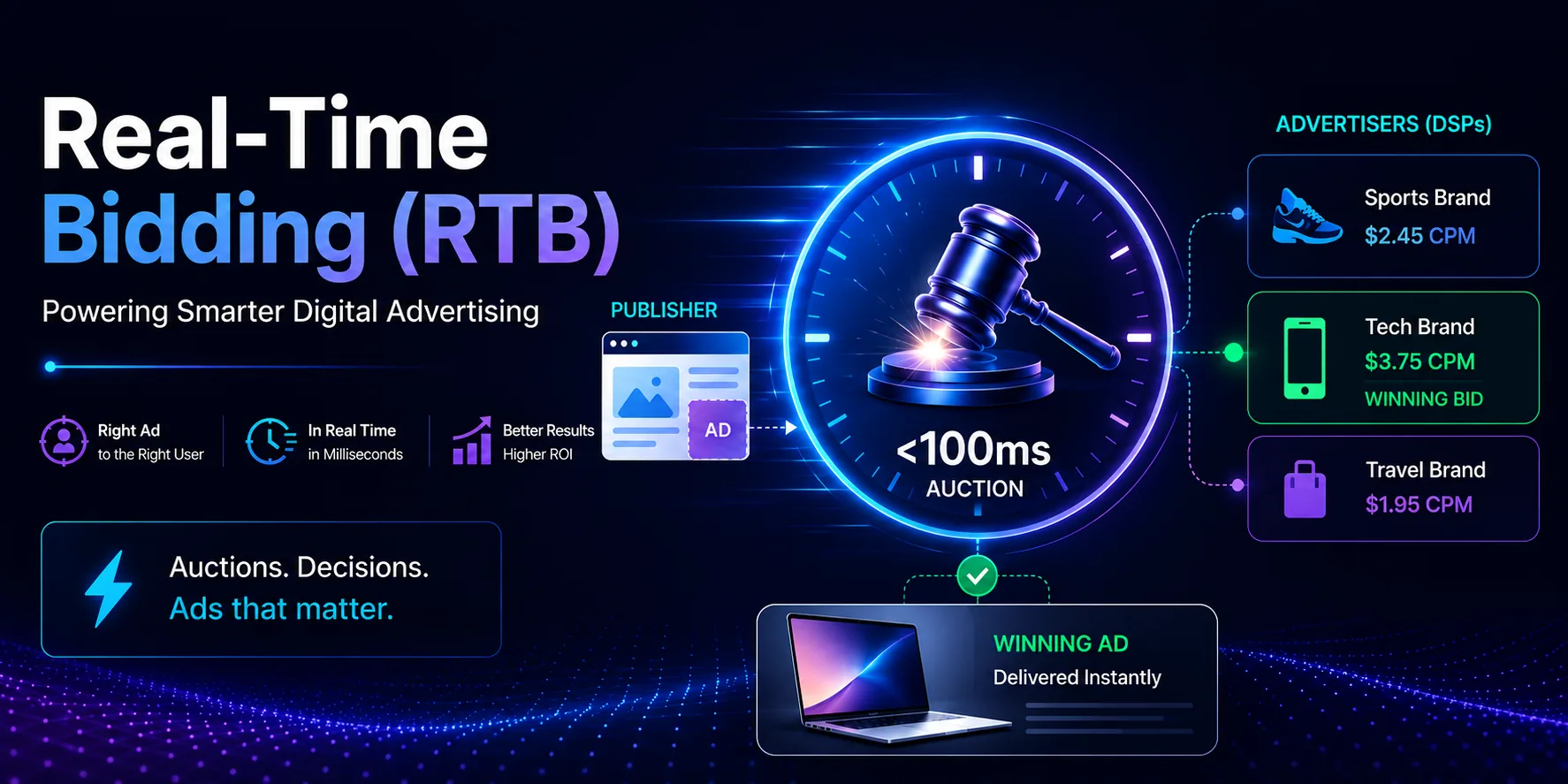
Every second, millions of digital advertisements are bought and sold across websites, mobile apps, and streaming platforms—without any human intervention. This happens through Real-Time Bidding (RTB), an automated auction system that powers modern programmatic advertising.
Whether you're reading a news article, shopping online, or watching a video, RTB determines which advertisement appears on your screen in less than 100 milliseconds. This technology enables advertisers to reach the right audience at the right moment while helping publishers maximize the value of every available ad impression.
What Is Real-Time Bidding (RTB)?
Real-Time Bidding (RTB) is an automated auction process used in programmatic advertising to buy and sell digital advertising inventory in real time.
Instead of purchasing advertising space manually, advertisers compete for each individual impression through an automated auction. The highest eligible bidder wins, and the advertisement is instantly served to the user—all before the webpage finishes loading.
Key Takeaways
- Automated auction for every ad impression
- Auctions complete in under 100 milliseconds
- Advertisers bid through Demand-Side Platforms (DSPs)
- Publishers monetize inventory through Supply-Side Platforms (SSPs)
- Higher relevance for users and better ROI for advertisers
Why Is RTB Important?
Traditional media buying relied on direct negotiations, fixed contracts, and bulk inventory purchases. While effective for some campaigns, this approach lacked flexibility and real-time optimization.
Real-Time Bidding transformed digital advertising by making campaign execution automated, scalable, and data-driven.
Benefits
- Automated media buying
- Smarter audience targeting
- Better Return on Ad Spend (ROAS)
- Faster optimization
- Efficient budget allocation
- Increased publisher revenue
How Does Real-Time Bidding Work?
The RTB process completes in less than 100 milliseconds and follows six simple steps:
- Users visit a website or app.
- The publisher sends an ad request.
- SSP forwards the request to an Ad Exchange.
- DSPs evaluate the opportunity and place bids.
- The highest eligible bid wins the auction.
- The winning advertisement is displayed instantly.
Real-World Example
Imagine Rahul is searching online for running shoes.
Later, he visits a fitness blog. As the webpage loads, multiple advertisers evaluate the available impression. A sportswear brand recognizes Rahul's recent interest in running shoes and submits the highest bid.
Within milliseconds, Rahul sees a personalized advertisement featuring the exact shoes he recently viewed.
This demonstrates how RTB delivers relevant ads while improving campaign performance and publisher revenue.
Benefits of RTB
For Advertisers
- Better audience targeting
- Higher campaign performance
- Flexible budget management
- Better ROI
- Access to premium inventory
For Publishers
- Higher fill rates
- Increased revenue
- Automated inventory sales
- More competition for inventory
For Users
- Relevant advertisements
- Better browsing experience
- Less irrelevant advertising
Key Performance Metrics
Every successful RTB campaign should monitor these metrics:
- Impressions
- CTR (Click-Through Rate)
- CPM (Cost per 1,000 Impressions)
- CPC (Cost per Click)
- CPA (Cost per Acquisition)
- Viewability
- Conversion Rate
Tracking these KPIs helps advertisers optimize campaigns and improve overall return on investment.
Challenges of RTB
Like any advertising technology, RTB has challenges that require ongoing attention.
- Ad Fraud
- Invalid Traffic (IVT)
- Brand Safety
- Privacy Regulations
- Cookie Deprecation
- Inventory Quality
Partnering with trusted AdTech providers and using high-quality first-party data helps overcome these challenges.
Conclusion
Real-Time Bidding has transformed the way digital advertising is bought and sold. By automating the buying process and evaluating every ad impression individually, RTB enables advertisers to deliver more relevant messages while helping publishers maximize the value of their inventory.
As artificial intelligence, machine learning, and privacy-first advertising continue to evolve, RTB will remain at the heart of programmatic advertising. Whether you're an advertiser, publisher, or AdOps professional, understanding how RTB works is essential for building successful digital advertising campaigns in today's competitive landscape.
Topics
Sankeerth
Ad Operations Professional at AdRefresh