
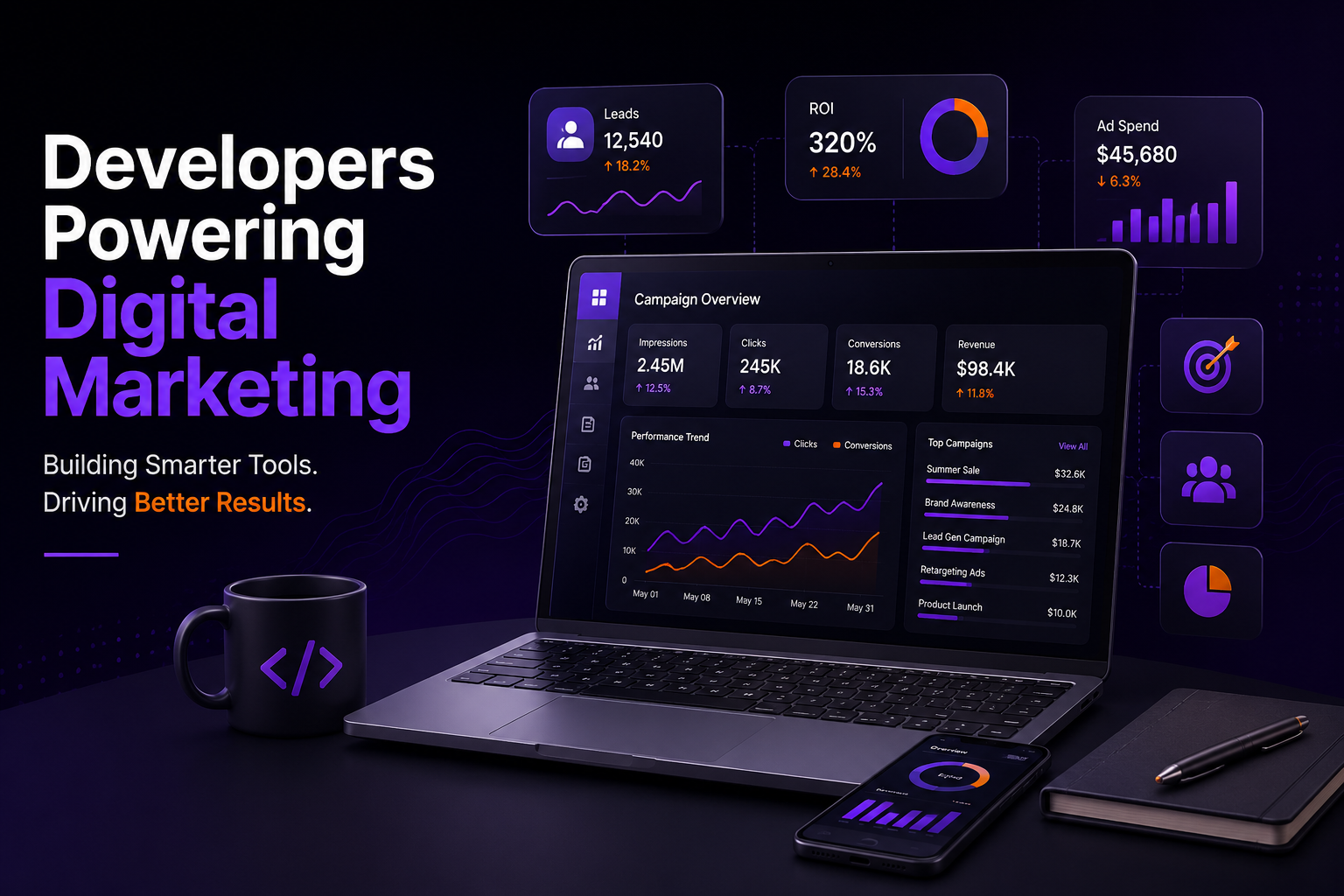
Digital marketing teams work with campaign data, leads, advertisements, reports, and performance metrics every day. Managing all of this information manually can become difficult as campaigns and operations grow.
Developers help by building internal tools that simplify these processes, reduce manual work, and make important marketing information easier to access.
Why Internal Tools Matter in Digital Marketing
Marketing teams often use multiple platforms for advertising, analytics, lead generation, reporting, and campaign management.
Internal tools bring important information together and help teams manage these workflows more efficiently. Instead of handling everything manually, marketing teams can use customized applications built around their specific requirements.
Campaign Dashboards
Marketing teams often need to monitor campaign performance across different platforms. Developers can bring important metrics into one dashboard, including:
- Impressions
- Clicks
- CTR
- Conversions
- Spend
- Revenue
- Campaign status
These dashboards make it easier to compare campaigns, monitor performance, and identify important changes.
Marketing Reporting Systems
Marketing teams regularly prepare daily, weekly, and monthly reports for campaigns and clients.
Developers can build reporting systems that collect and organize campaign data automatically. This reduces repetitive work and makes reports faster and more consistent.
Benefits of Automated Reporting
- Reduces manual data collection
- Saves time
- Creates consistent reports
- Makes campaign information easier to access
- Helps teams focus more on analysis
Lead Management Systems
Digital marketing campaigns can generate leads from multiple sources. Keeping this information organized is important for tracking campaign performance and conversions.
Developers can build lead management systems that keep important information in one place.
A lead management system can include:
- Lead source
- Campaign
- Landing page
- Contact information
- Lead status
- Assigned employee
- Follow-up status
- Conversion status
- Date and time of submission
A typical lead flow can look like:
Advertisement → Landing Page → Form → API → Database → Lead Dashboard
This gives marketing teams better visibility into their leads and their sources.
Marketing Automation
Marketing teams perform many repetitive tasks such as collecting campaign information, updating reports, sending notifications, and processing leads.
Developers can automate these workflows so that the required information is collected and processed with less manual effort.
Common Marketing Tasks That Can Be Automated
- Campaign data collection
- Report updates
- Lead processing
- Notifications
- Data synchronization
- Performance checks
Automation allows marketing teams to spend more time on campaign strategy and optimization.
Ad Performance Monitoring
AdOps teams may manage multiple campaigns, websites, placements, and advertising metrics. Monitoring all of them manually can become difficult as operations grow.
Developers can build monitoring tools that bring important performance information together.
A monitoring system can help teams identify:
- Sudden performance drops
- Campaign delivery issues
- Changes in traffic
- Low-performing ad placements
- Unexpected metric changes
- Revenue fluctuations
- Campaign status changes
This helps AdOps teams identify issues faster and take action when required.
Building Internal Admin Panels
Internal applications also need a simple way to manage users, clients, campaigns, leads, and reports.
Developers can build admin panels that allow authorized employees to manage:
- Users
- Clients
- Campaigns
- Leads
- Reports
- Permissions
- Account settings
- Internal configurations
Role-based access can also be used to ensure that different users only have access to the information and features they need.
Connecting Different Marketing Platforms
Marketing data often comes from different advertising, analytics, CRM, lead generation, and reporting platforms.
Developers can connect these systems through APIs and backend services, allowing information to move between different platforms and internal applications.
A typical workflow can look like:
Marketing Platform → API → Backend → Database → Internal Dashboard
This reduces manual data movement and creates a more connected marketing workflow.
Using Databases to Organize Marketing Data
Internal marketing tools need structured data to manage campaigns, leads, clients, reports, and performance information.
Developers can use SQL databases to organize this information and make it available to internal applications.
This also makes it easier to retrieve data for reporting, analysis, and decision-making.
Building Better Workflows for Marketing Teams
Developers can look at existing marketing processes and identify repetitive steps that can be simplified or automated.
For example:
Manual Process :-
Collect data → Update spreadsheet → Calculate metrics → Create report → Send report
Improved Workflow :-
Data collection → Automated processing → Dashboard → Report generation
The result is less manual work and a more efficient workflow for the marketing team.
How Next.js and Full-Stack Development Fit Into Marketing
Full-stack development allows developers to build complete internal applications for marketing teams.
Next.js can be used for dashboards, reporting interfaces, forms, and admin panels, while backend services, APIs, and databases handle business logic, integrations, and marketing data.
Technologies such as Next.js, Node.js, MERN, and SQL can support different parts of the marketing workflow.
Security and Access Control
Internal marketing systems can contain client information, leads, campaign data, and performance reports.
Developers can implement authentication, authorization, role-based permissions, and secure APIs to control access to this information.
This helps keep internal applications secure while giving employees access to the information they need.
Turning Marketing Data Into Business Decisions
Internal tools can organize raw marketing data into useful metrics, trends, comparisons, and visualizations.
This helps marketing teams quickly understand campaign performance and identify where improvements are needed.
Instead of spending time collecting data, teams can focus on questions such as:
- Which campaign is performing best?
- Which source is generating more leads?
- Where is performance declining?
- Which areas need optimization?
This is where development, data, and marketing strategy come together.
Developers as Part of the Marketing Ecosystem
Developers in digital marketing companies do more than maintain websites or fix technical issues.
They build systems that help marketing teams collect information, automate workflows, monitor campaigns, manage leads, and understand performance.
The developer becomes an important connection between:
Marketing + Data + Technology + Automation
This collaboration helps marketing teams work more efficiently and scale their operations.
The Future of Internal Marketing Tools
As digital marketing becomes more data-driven, companies will continue to rely on automation, connected platforms, dashboards, and intelligent monitoring systems.
Developers will play an important role in building these systems and integrating new technologies into existing marketing workflows.
The future is not simply about having more marketing tools. It is about having the right technology working together to create faster and more efficient operations.
Conclusion
Digital marketing and Web development are becoming increasingly connected.
Campaign dashboards, reporting systems, lead management platforms, automated reports, ad performance monitoring, and admin panels are some of the ways developers support modern marketing operations.
The technology may work behind the scenes, but it helps marketing teams save time, improve visibility, and make better decisions.
Topics
Revanth
Full Stack Developer at AdRefresh