
Introduction
In recent decades, digital advertising has undergone significant changes. In previous years, advertising companies contacted publishers directly, agreed on prices and booked advertising space manually. This procedure was not always quick and required extensive negotiation.
Nowadays, these operations are mainly carried out within the framework of programmatic advertising. Unlike manual advertisement purchasing, in programmatic advertising, advertisement space is purchased automatically using advanced technology.
Ad exchanges are an integral part of programmatic advertising. They may be regarded as online advertising marketplaces where advertisers acquire advertisement space and publishers sell theirs in real time. Thus, ad exchanges assist in targeting the target audience and enable publishers to generate additional revenue from their available advertisement inventory.
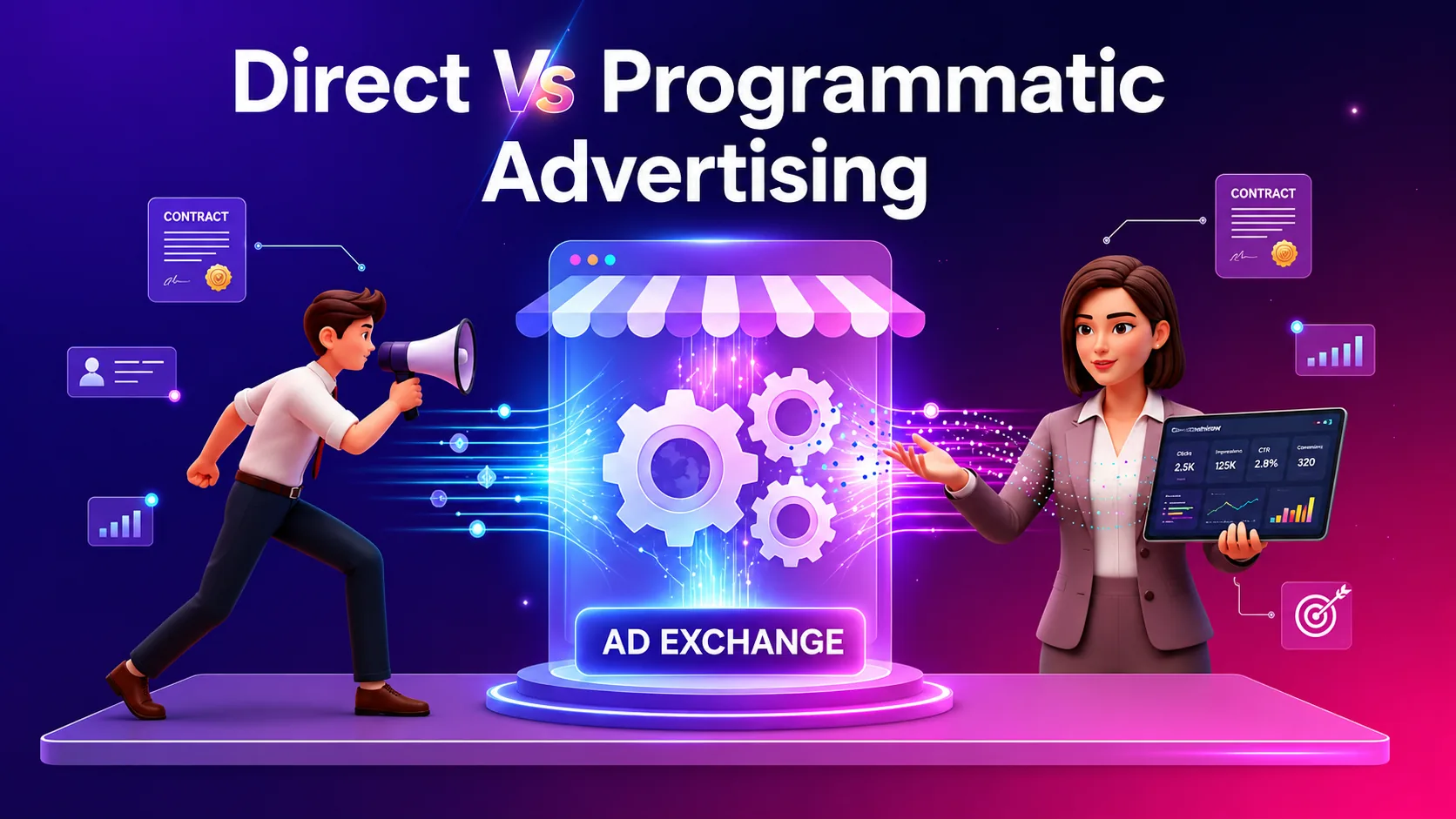
When exploring the essence of contemporary digital advertising, it is vital to distinguish between direct and programmatic advertising. Comparison of the two types of advertising will illustrate the reasons behind the popularity of programmatic buying.
Direct Advertising: The Traditional Way to Buy Digital Ads
Direct advertising is the traditional way of buying and selling online ads. In this method, advertisers work directly with publishers to place their ads on websites, apps, or other digital platforms.
The process usually includes:
- Contacting the publisher directly
- Discussing and agreeing on the price
- Choosing where the ads will appear
- Running the campaign for a fixed time or number of impressions
This method is still popular for premium websites and brands that want complete control over where their ads are shown.
Advantages of Direct Advertising
- Greater control over where ads are displayed
- Better brand safety because advertisers know exactly where their ads will appear
- Access to premium websites and high-quality ad placements
- Strong relationships between advertisers and publishers
Limitations of Direct Advertising
While direct advertising has its benefits, it also comes with some challenges:
- The buying process is manual and takes more time
- It is difficult to manage large campaigns across many websites
- Campaigns cannot be optimized instantly based on performance
- Decisions rely less on real-time data and audience behavior
- Once a campaign is live, making changes can be slow and difficult
As people use more websites, apps, and devices than ever before, these limitations have made it harder for direct advertising to keep up. This is one of the main reasons why many advertisers have shifted to programmatic advertising.
Programmatic Advertising: A Smarter Way to Buy Digital Ads
Programmatic advertising is the modern way of buying and selling digital ad space. Instead of manually contacting publishers and negotiating deals, advertisers use technology to buy ads automatically.
This process is powered by platforms such as:
- Demand-Side Platforms (DSPs): Help advertisers buy ad space.
- Supply-Side Platforms (SSPs): Automate the process of selling publishers' ad inventory.
- Ad Exchanges: Automated marketplaces that enable advertisers and publishers to trade digital ad inventory in real time.
Whenever a user visits a website or opens an app, programmatic advertising technology runs an instant auction to determine which ad will appear. This process is called Real-Time Bidding.
Before displaying an ad, the system looks at different signals, such as:
- User interests and browsing behavior
- Device type (mobile, tablet, or desktop)
- Geographic location
- The content being viewed
- Previous interactions with ads
Using this information, the system selects the most relevant ad for that user, helping advertisers reach the right audience at the right time.
Why Businesses Choose Programmatic Advertising
Programmatic advertising has become the preferred choice for many businesses because it offers several advantages:
- Automates the entire ad-buying process
- Reaches millions of users across websites, apps, and devices
- Uses real-time data to improve campaign performance
- Delivers ads to the most relevant audience
- Continuously optimizes campaigns for better results
By automating media buying and using data to make smarter decisions, programmatic advertising makes digital campaigns faster, more efficient, and more effective than traditional advertising.
What Are Ad Exchanges?
Ad exchanges are digital marketplaces where advertisers and publishers trade ad inventory in real time. As a core component of the programmatic advertising ecosystem, they automate the ad-buying process, making it faster, more efficient, and data-driven.
When a user visits a website or opens an app, the ad exchange instantly matches available ad space with advertisers looking to reach that user. This happens in just a few milliseconds through Real-Time Bidding (RTB).
Ad exchanges work with platforms such as:
- Demand-Side Platforms (DSPs): Used by advertisers to buy ad inventory.
- Supply-Side Platforms (SSPs): Automate the process of making publishers' ad inventory available to advertisers.
- Ad Exchanges: Digital marketplaces that connect advertisers and publishers for the automated buying and selling of ad inventory.
Why Ad Exchanges Are Important
Ad exchanges have become the foundation of modern digital advertising because they:
- Connect advertisers and publishers instantly
- Run automated real-time bidding auctions
- Provide access to ad inventory across thousands of websites and apps
- Offer transparent pricing and reporting
- Support different buying methods, including Open Auctions, Private Marketplaces (PMPs), and Programmatic Guaranteed deals
By connecting buyers and sellers in real time, ad exchanges help advertisers reach the right audience while helping publishers maximize the value of every ad impression.
Types of Programmatic Deals in Ad Exchanges
Not all programmatic advertising works the same way. Advertisers and publishers can choose different types of deals based on their goals, budget, and the level of control they need.
-
Open Auction: Open Auction is the most common type of programmatic deal. Any advertiser can participate in a real-time bidding (RTB) auction, and the highest bidder wins the ad impression.
-
Private Marketplace(PMP): A Private Marketplace is an exclusive, invitation-only auction where publishers make premium ad inventory available to selected advertisers. This provides advertisers with access to high-quality placements while giving publishers greater control over who can bid.
-
Programmatic Guaranteed(PG): In a Programmatic Guaranteed deal, advertisers and publishers agree on a fixed price for a reserved amount of ad inventory before the campaign begins. While the transaction is automated, the inventory is secured in advance, ensuring guaranteed delivery.
-
Preferred Deals: Preferred Deals let advertisers negotiate a fixed price with a publisher before the inventory is offered through an open auction. Advertisers receive the first opportunity to purchase the available impressions, but they are not obligated to buy them.
Each deal type offers a different balance of cost, control, and access, allowing advertisers to choose the option that best fits their campaign objectives.
Why Ad Exchanges Are Better Than Direct Buying
Access thousands of websites and apps through a single platform, making it easy to scale campaigns.
-
Improve Campaign Performance: Campaigns are automatically optimized using live performance data to deliver better results.
-
Reach the Right People: Ads are shown to users based on their interests, browsing behavior, location, and other real-time signals.
-
Get More Value from Your Budget: Advertisers bid only on valuable impressions, helping reduce wasted ad spend.
-
Track Everything Clearly: Detailed reports provide insights into campaign performance, pricing, and inventory.
-
Advertise Across Multiple Channels: Run campaigns across websites, mobile apps, Connected TV (CTV), and other digital platforms from one place.
-
The Future of Programmatic Advertising: Programmatic advertising continues to grow as privacy regulations evolve, AI becomes more advanced, and businesses rely more on first-party data. Ad exchanges will remain essential by providing transparent, data-driven, and scalable advertising solutions.
Conclusion
Digital advertising has evolved from manual buying to automated, data-driven campaigns. While direct advertising is still valuable for premium placements, programmatic advertising offers greater speed, scalability, and efficiency.
Powered by ad exchanges, programmatic advertising helps businesses reach the right audience, improve campaign performance, and make better use of their advertising budget. As digital marketing continues to grow, ad exchanges will remain at the center of modern media buying.
Topics
Abhiram
Paid Media Analyst at AdRefresh