
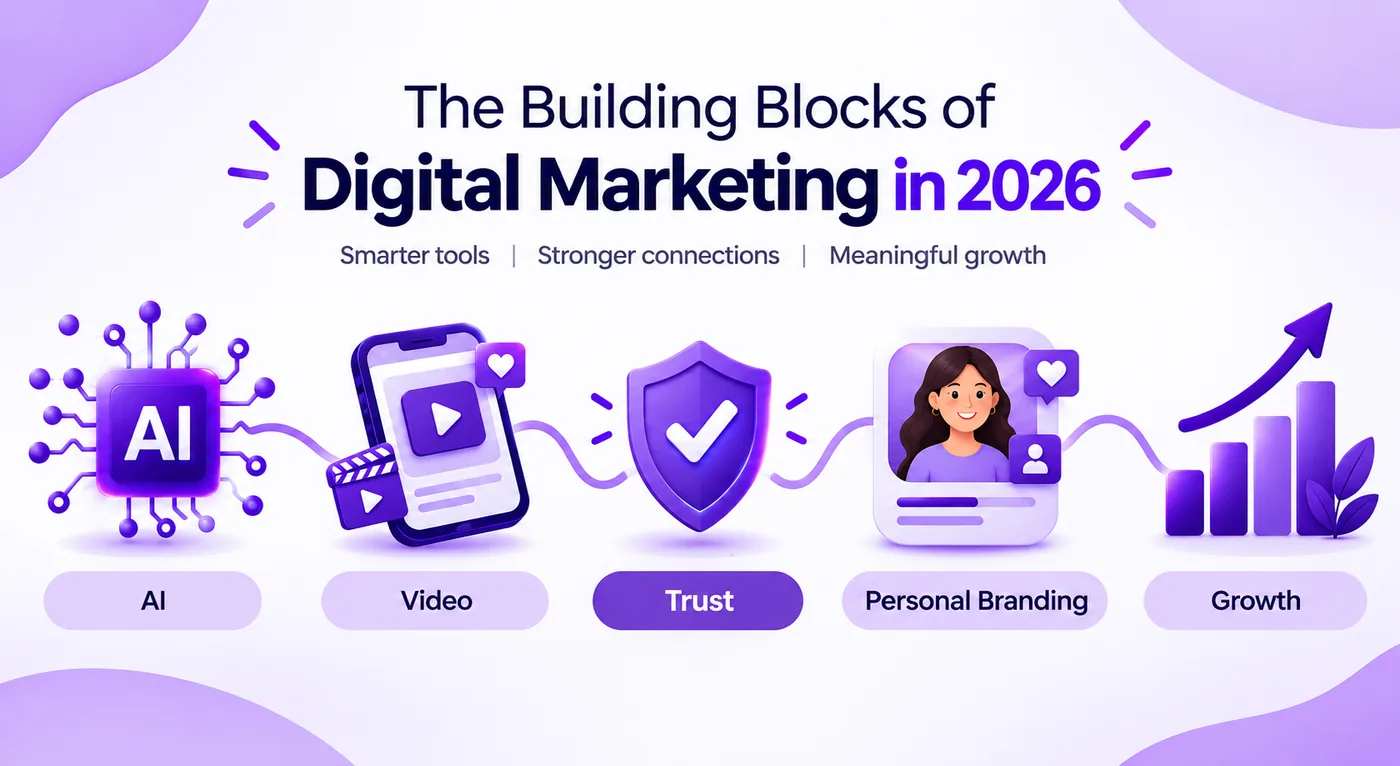
Digital marketing is no longer a collection of separate channels working independently.
A customer might see a brand on social media, watch a video about its product, search for the company later, read reviews, visit its website and finally make a purchase through an advertisement.
That change is becoming even more noticeable in 2026.
Artificial intelligence, search, paid media, video, data, content and brand-building are increasingly connected. Businesses that treat each activity as a separate function may miss opportunities to understand how customers actually move from awareness to consideration and, eventually, conversion.
The question for marketers is therefore changing.
It is no longer simply about getting more clicks, impressions or followers.
It is about creating a connected journey that brings the right people to the business, gives them useful information and encourages meaningful action.
In this article, we explore some of the major developments influencing digital marketing in 2026 and what businesses can do to respond in a practical way.
How Digital Marketing Is Evolving in 2026
For many years, digital marketing success was closely associated with visibility.
More traffic was good. More impressions were good. More followers were good.
These numbers still have a place in reporting, but they don't necessarily explain whether marketing activity is contributing to business growth.
A campaign may generate thousands of visits without producing meaningful leads. A social post may receive strong engagement without influencing a purchase. On the other hand, a smaller campaign may bring fewer visitors but generate highly relevant customers.
This is why marketing teams are looking more closely at what happens after the first interaction.
This shift brings several important questions into focus:
- Are visitors finding the information they need?
- Are prospects taking the next step?
- Are marketing activities generating qualified opportunities?
- Are customers returning?
- Is advertising contributing to profitable growth?
- Which parts of the customer journey are influencing the final decision?
The result is a broader approach to marketing.
Instead of focusing only on generating traffic, businesses need to understand how different touchpoints work together to move customers forward.
1. AI Is Reshaping Everyday Marketing
Artificial intelligence has quickly moved from an emerging technology to a practical part of many marketing workflows.
Today, marketers can use AI to speed up tasks such as research, analysis, content development and reporting.
AI can support a range of marketing activities, depending on the tools and objectives involved:
- Finding audience insights
- Analysing campaign performance
- Generating content ideas
- Researching search topics
- Creating advertising variations
- Identifying performance patterns
- Supporting forecasting
- Preparing reports
- Automating repetitive processes
- Highlighting potential areas for improvement
The important distinction, however, is between using AI as a tool and letting AI determine the entire marketing strategy.
For example, imagine an ecommerce campaign suddenly starts generating fewer sales.
An automated system may quickly identify the performance decline. But the numbers alone may not explain what caused it.
The reason could be:
- A website issue
- Changes in product availability
- A new competitor offer
- A change in customer demand
- Tracking problems
- Less effective creative
- A change in the audience being reached
This is where human judgement remains important.
AI can help marketers process information faster, identify patterns and reduce repetitive work. People still need to interpret those signals and understand the wider business situation.
Where marketers can add more value
As automation handles more routine activities, marketing professionals can dedicate more time to areas that require judgement and creativity.
These include:
- Strategy
- Creative development
- Customer understanding
- Experimentation
- Business analysis
- Decision-making
The future is therefore unlikely to be simply about humans versus AI.
A more practical model is people using AI to work more effectively.
When technology handles repetitive work while marketers remain responsible for context and strategic decisions, businesses can move faster without losing the human perspective.
2. Search Is Moving Towards More Conversational Experiences
The way people search online is changing.
Traditional searches were often short and direct.
For example:
"digital marketing agency Hyderabad"
Today, users can ask much more detailed questions.
The growth of AI-assisted search is also changing how people discover information. Rather than searching once, opening a result and starting another search, users can increasingly ask follow-up questions and explore a topic through a conversation.
For businesses, this creates a broader content challenge.
Focusing on one keyword alone is no longer sufficient.
A website needs to demonstrate that it can provide useful information across the wider topic a potential customer is researching.
Relevance matters more than keyword volume
Instead of starting with:
"How many keywords should we target?"
marketers should also ask:
"What questions is our audience trying to answer?"
That shift can lead to content that is more useful, more relevant and better aligned with the customer's actual intent.
3. Video Is Becoming an Important Part of Discovery
People use video to learn, research, compare and understand products and services before making decisions.
Depending on the industry, video can help customers:
- Understand a product
- Learn how a service works
- Compare different options
- Follow a tutorial
- Discover a company
- Hear from industry experts
- Research a potential purchase
This creates an opportunity for businesses to think beyond individual social posts.
One strong piece of content can often become several different formats.
For example:
Detailed article → Short video → Social post → Carousel → Email content
The idea is not to publish the exact same material everywhere.
Why short-form video matters
Short videos can be particularly useful when an idea can be communicated quickly.
A technology company could demonstrate one feature.
A retailer could show how a product is used.
A service provider could answer a common customer question.
A consultant could explain one industry challenge.
The purpose should not be to create video simply because video is popular.
The better question is:
Would video help our audience understand this information more easily?
If the answer is yes, video becomes a useful part of the customer journey.
Quality still matters
Publishing more videos does not automatically create a stronger video strategy.
Good content should be:
- Relevant
- Clear
- Easy to follow
- Visually engaging
- Consistent with the brand
- Useful to the intended audience
The focus should be on helping the viewer rather than simply increasing the number of pieces published.
4. Human Expertise Is Becoming More Important for Brands
People don't only want to know what a company sells.
Increasingly, they also want to understand the people and expertise behind the company.
This is one reason founder-led, expert-led and employee-led content can add value to a brand's digital presence.
Customers may want to know:
- Who is behind the business?
- What experience does the team have?
- Which problems has the company solved?
- What does the company understand about its industry?
- What lessons has the team learned?
This can be particularly relevant for B2B companies, where customers may spend considerable time researching a potential partner before making a decision.
Instead of publishing only promotional statements, companies can use their internal expertise to create useful content.
For example, rather than saying:
"We provide complete digital marketing solutions."
a company could share:
"Three tracking issues businesses often encounter when expanding campaigns across multiple markets."
The second approach gives the audience something useful while demonstrating practical knowledge.
Turning internal expertise into content
Companies can bring different perspectives into their marketing through:
- Founder stories
- Employee insights
- Customer experiences
- Behind-the-scenes content
- Industry observations
- Educational posts
- Case studies
This doesn't mean every employee needs to become a content creator.
The opportunity is simply to make the knowledge already present within the organisation more visible.
A strong corporate brand and authentic individual voices can support each other.
5. First-Party Data Is Becoming More Important
Data has always been central to digital marketing.
But collecting more information does not automatically mean having better marketing intelligence.
Data needs to be accurate, relevant and collected responsibly.
First-party data refers to information a business gathers directly through its own interactions with customers and prospects.
This could include:
- CRM records
- Email subscriptions
- Website activity
- Purchase information
- Customer enquiries
- Lead details
- Loyalty programme activity
- Account interactions
When managed correctly, this information can help businesses understand existing customers and deliver more relevant experiences.
But there is another side to the conversation: responsibility.
Customers increasingly expect businesses to be clear about how their information is collected and used.
That makes areas such as these increasingly important:
- Consent
- Transparency
- Data security
- Data accuracy
- Appropriate usage
- Customer expectations
Privacy should not be something considered only after a marketing campaign has been designed.
It should form part of the strategy from the beginning.
6. Marketing Measurement Is Moving Closer to Business Outcomes
One of the biggest challenges in digital marketing is understanding what actually contributed to business results.
A campaign can generate:
- Impressions
- Clicks
- Website visits
- Leads
- Sales
- Revenue
But these metrics don't always tell the same story.
A campaign might generate an impressive click-through rate but very few sales.
Another campaign might receive less traffic but attract customers with significantly higher purchase values.
This is why measurement needs to begin with the business objective.
The right metrics depend on the business
For an ecommerce company, useful indicators may include:
- Revenue
- Conversion rate
- ROAS
- Average order value
- Customer acquisition cost
- Repeat purchases
For a B2B organisation, the focus could instead be on:
- Qualified leads
- Cost per lead
- Lead-to-opportunity rate
- Pipeline contribution
- Customer acquisition cost
For a publisher, relevant measurements may include:
- Revenue
- Fill rate
- CPM
- Yield
- Inventory performance
There is no universal metric that defines success for every company.
7. Building a Digital Marketing Strategy for 2026
The number of available platforms, tools and technologies can make digital marketing feel complicated.
There is always another platform to test, another format to explore and another technology promising better results.
Trying everything at once, however, can create unnecessary complexity.
A stronger approach is to build the strategy around a few fundamentals.
Start With the Business Objective
Before selecting channels, understand what the company is trying to achieve.
For example:
- Increase sales
- Generate qualified leads
- Build awareness
- Enter a new market
- Improve customer retention
- Increase brand visibility
The objective should influence both channel selection and measurement.
Build Reliable Data Foundations
Marketing decisions depend on the information available to the team.
Make sure tracking, analytics and campaign structures are set up correctly before relying heavily on performance data.
Accurate information creates a stronger foundation for testing and improvement.
Create Content That Helps People
Every piece of content should have a reason to exist.
It could answer a question, solve a problem, explain a product or help a potential customer make a decision.
The goal should not simply be to fill the content calendar.
Useful content has a purpose beyond publication.
Use AI Where It Makes Sense
AI can accelerate research, analysis, content development and repetitive processes.
But important decisions should still receive human review.
The best use of AI is not necessarily replacing existing workflows completely. In many cases, it is about helping teams spend less time on repetitive work and more time on higher-value activities.
Keep Testing and Learning
Digital marketing does not remain static.
Customer behaviour changes.
Competitors change their strategies.
Advertising platforms introduce new features.
Search experiences evolve.
Creative preferences change.
Because of this, marketing needs to be treated as an ongoing process rather than a one-time setup.
A simple framework is:
Plan → Launch → Measure → Learn → Improve → Repeat
The objective is not to make every campaign perfect from the beginning.
It is to build a system that learns from performance and becomes more effective over time.
8. How AdRefresh Supports Modern Digital Marketing
Modern digital marketing involves more than creating campaigns.
Behind every campaign are the people, processes, technology, data and operational systems that keep everything moving.
At AdRefresh, our approach combines digital marketing, advertising operations, technology and performance-focused execution.
We see technology as a way to simplify marketing operations and help teams work more efficiently.
Automation can reduce repetitive manual tasks.
Analytics can help teams identify patterns and opportunities.
Advertising platforms can process large volumes of information.
But technology alone does not replace experience.
People are still needed to understand the business context, question the data and determine what actions make sense.
That combination of technology, operational discipline and human expertise is central to how we approach modern marketing.
Conclusion
Digital marketing in 2026 is not about finding one new platform and expecting it to change everything.
The bigger opportunity is to build a marketing system that can respond as customers, technology and platforms evolve.
AI is changing how marketing teams work. Search is becoming more conversational. Video is playing a larger role in discovery and research. Expert-led content is giving brands more human voices. First-party data is becoming increasingly important. Measurement is becoming more closely connected to commercial outcomes.
None of these developments exists in isolation. Together, they point towards a more connected approach to digital marketing.
For businesses, the focus should be on understanding their audience, creating genuinely useful content, establishing reliable data foundations, measuring meaningful outcomes and continuously learning from performance.
Technology will continue to evolve.
The fundamentals of good marketing remain remarkably consistent:
Understanding our audience. Create something useful. Measure what matters. Learn from the evidence.
Topics
Manjunath
Paid Media Analyst at AdRefresh